
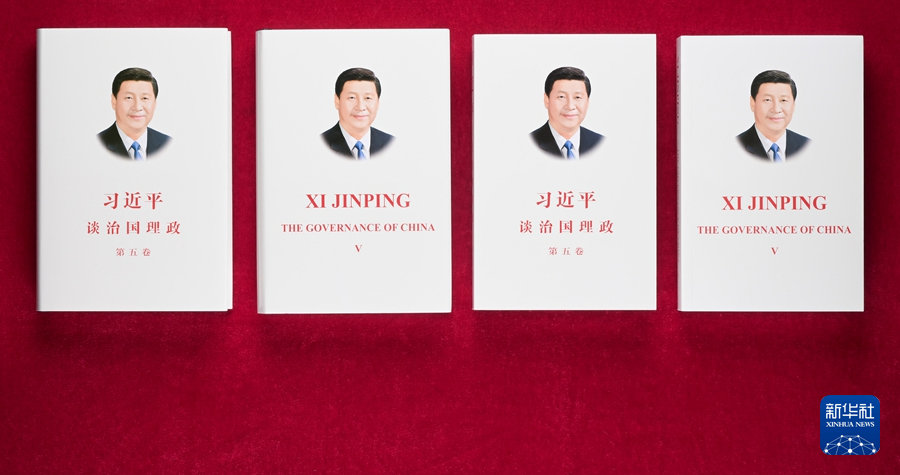
Book review of Xi Jinping’s The Governance of China, Volume IV


- Gokarna Bhatta-
China, a land with a glorious civilization and rich cultural traditions spanning centuries, began to experience exploitation by feudal and foreign powers after the Opium Wars in the 17th century. The Chinese society was increasingly destabilized by domestic feudal oppression and foreign aggression. Amid these challenges, the Chinese people launched multiple struggles to resist foreign control and feudal exploitation. The true momentum for liberation came only in 1921, after the October Revolution in Russia inspired Marxist ideals to take root in China, leading to the establishment of the Communist Party of China (CPC). China, a land with a glorious civilization and rich cultural traditions spanning centuries, began to experience exploitation by feudal and foreign powers after the Opium Wars in the 17th century.
Under the CPC leadership, China fought a fierce, transformative struggle to end foreign domination and internal feudal exploitation.The people achieved a landmark victory, gaining freedom from both foreign oppressors and domestic landlords, moneylenders, and feudal lords. From a war-ravaged state, China transformed into one of the world’s most powerful economies, now ranking as the second-largest in terms of prosperity.
The profound review of the Chinese people's struggle-filled journey can be found in the collected writings of President Xi Jinping.
On the occasion of the CCP’s 100th anniversary in 2021, Chinese President and General Secretary Xi Jinping addressed the nation, reviewing the party’s century-long journey which is published in the first chapter of The Governance of China, Volume IV. The article offers a comprehensive look into the Chinese Communist Party's (CCP) achievements, challenges, and future direction. This review captures how Xi reflects on the Party’s centenary milestone in 2021, providing both a historical review and a forward-looking blueprint for continued socialist development with Chinese characteristics.
Xi emphasizes China’s five-thousand-year-old civilization and recalls the nation’s suffering under semi-colonial and semi-feudal conditions after the Opium Wars. He references early uprisings, such as the Taiping Rebellion and the 1911 Revolution, which ultimately failed before Marxism entered China. According to Xi,
''The founding of a communist party in China was an epoch-making event, which profoundly changed the course of Chinese history in modern times, transformed the future of the Chinese people and nation, and altered the global landscape''
Xi highlights that, from 1921 to 1949, the CCP led the people to liberation from all forms of oppression. He explains that the success of the 'new democratic revolution' unified China, ending its semi-colonial, semi-feudal status and creating the social conditions for national rejuvenation. As the CCP continued its mission of socialist construction, Xi argues that only socialism could deliver the strength and unity China needed to progress. He writes,
''Through tenacious struggle, the Party and the Chinese people showed the world that the Chinese people were capable of dismantling the old world and building a new one, and that only socialism could save China, and only socialism could enable China to develop.''
Xi highlights how, following the success of the revolution and the modernization efforts from 1978 onwards, China’s unique socialist path proved successful, demonstrating its viability to the world. He acknowledges the contributions of Mao Zedong, Deng Xiaoping, Jiang Zemin, Hu Jintao, Zhou Enlai, Liu Shaoqi, and other revolutionary leaders, paying them high respect. Xi regards the collective struggle and sacrifice of countless CCP members, farmers, workers, intellectuals, and people from all walks of life as the foundation of modern China. Reflecting on the CCP’s century-long journey, Xi quotes Mao Zedong, who said,''Our minds grow stronger for the martyrs, sacrifice, daring to make the sun and the moon shine in the new sky.''
Based on historical lessons, Xi outlines nine core responsibilities for the CCP and its members, in building socialism with Chinese characteristics. Reflecting on historical lessons, he identifies nine key responsibilities for the CCP and its members:
1. Uphold and strengthen the Party’s leadership.
2. Unite and lead the Chinese people in tirelessly working for a better life. The Party’s foundation lies in the people, from whom it derives strength.
3. Adapt Marxism to the Chinese context, uphold Marxism-Leninism, Mao Zedong Thought, Deng Xiaoping Theory, the Three Represents, and the Scientific Outlook on Development, and fully implement the thought on socialism with Chinese characteristics for a new era.
4. Continue to develop socialism with Chinese characteristics.
5. Accelerate the modernization of national defense and armed forces. A strong country requires a strong military.
6. Work toward building a global community with a shared future.
7. Engage in the historic struggle with new features.
8. Strengthen the unity of the Chinese people, balancing commonality and diversity.
9. Advance the great new project of strengthening the Party. Self-governance is an unending journey.
Xi stresses the need for a strong Communist Party with a leadership that fosters creative development by centering on the people, ensuring unity across all ethnicities, classes, and communities, and systematically moving forward in constructing socialism. This is highly relevant to Nepal as well as we are aspiring for the development focused on people. He also highlights the importance of security and emphasizes the CCP’s role in creating a new global order.
Addressing the One-China policy, Xi reaffirms the commitment to Hong Kong and Macau’s unique political systems and expresses a commitment to the peaceful reunification of Taiwan, adhering to the 1992 consensus.
As he concludes, Xi recalls that the CCP, which began with only 50 members, now has tens of millions. He calls on Party members to remain steadfastly aligned with the people:
''Acting on the aims of the Party, you should always maintain close ties with the people, empathize and work with them, stand with them through good times and testing times, and continue working tirelessly to realize their aspirations for a better life and bring still greater glory to Party and the people.''
This essay showcases Xi Jinping’s strong dedication to Marxist principles and the Communist Party’s commitment to serving the people. At a time when some argue that Marxism is no longer relevant globally, Xi reaffirms that socialism, grounded in Marxist ideas, is essential for achieving people’s liberation and prosperity. This is the need of today’s world as Marxism needs to fit each society's unique historical context. Xi places great importance on a strong Communist Party and its deep connection with the people, firmly stating that the Party’s primary duty is to serve the public. Overall, this piece provides guidance and inspiration for progressive parties globally, outlining the path and role they might take in today’s world.
Xi's reflections in The Governance of China, Volume IV offers a deep and strategic view of the Party’s legacy, reinforcing its central role in China’s ongoing journey toward modern socialist development. China’s advancements in infrastructure, information technology, medical- science, development and a robust, self-reliant economy serves as an inspiration for other nations of the world to learn from China.
(Bhatta is a central committee member of CPN Maoist Centre.)




प्रतिकृया दिनुहोस